“I was right, I am the only girl. AGAIN!”

This is the fourth summer in a row that my youngest daughter, now 13, has done some sort of a programming camp. For three out of four summers, she has been the only girl in her group. While I commend these programs for a great curriculum and instructors, this has caused me to think about how, as parents and a community, we need to step up efforts on gender balance in computing much earlier than college or even high school. If girls are not participating in programs like this in their formative years, how are to expect them to be computer science majors or pursue technical careers?

As we walked to Harvard this summer for her first day of camp, my daughter was a bit anxious about yet another digitalmediaacademy.orgsummer as the token girl. We had chosen a new program through Digital Media Academy (DMA) largely because they were one of the few to offer a Virtual Reality course where she could play with Oculus Rift and learn how to design virtual worlds. A second major factor was that much of the DMA website and materials are full of images of girls having fun with technology – suggesting they are very successful in recruiting girls to sign up for their courses.

In response to “Mom, if I am the only girl again this summer I am going to be so mad.” I tried to be encouraging and focus on the coolness of the course she was taking. I told her how leading edge she was to learn about an emerging technology before most people her age even knew what it was. I didn’t talk about the potential gender imbalance and instead focused on the fact that this was about pursuing her interests and passions. Inside though, I was hoping…no praying…she wasn’t the only one. Not just because I didn’t want her to be the one girl among the boys, but for the bigger picture. I was dying for a sign that the canaries were singing loudly in the coal mine. Hopeful that I would see a mixed group of boys and girls in the room eager to dig into technology.

The canaries weren’t singing…

When we arrived at the camp check-in area, we were relieved to see a few other girls signing in and heading off to their classrooms. The counselors whisked my daughter away to her classroom so I didn’t have a chance to see the gender composition. I asked her to text me at lunch with a pulse on how it was going.

As I walked back home, I reflected on the prior three summers. The first summer, she signed up for a game design course through ID Tech, hosted at MIT. The boys in this class were obsessed with Pokemon cards – something my daughter knew nothing about and had no interest in – and their break time was used to trade cards or play video games. As a pretty typical 10 year-old girl, she would have rather spent her lunch break talking about boy bands and Youtubers or maybe tossing a frisbee around outside. Needless to say, between that and being among a group of 8-10 year-old boys with zero interest in socializing with girls, my daughter felt pretty isolated among the group. Outside of learning a bit of Javascript, she was pretty disappointed with the experience that year.

The following year, I decided to combine a week I needed to spend at VMware’s Palo Alto HQ with an opportunity for her to try ID Tech again, but this time hosted at Stanford. She was willing to give it another try, thinking it was cool to “attend Stanford”. Once again, I dropped her off at the sign-in area and hoped for a better outcome than we experienced on the MIT campus the prior summer. At pickup time, she joyfully jumped in my rental car bubbling over about all the fun girls who were in her mobile app game design class. Just like her, some were there because their parents were in the valley for work and others were locals and long-time ID Tech participants. Not only did she have a lot more fun than the prior summer, but she accomplished a lot more in that week than I would have expected. We were both thrilled.

Flash forward to last summer and another year with ID Tech at MIT. My daughter was pretty into Minecraft at the time and was eager to go deep and get better at programming in general. She is a very go-with-the-flow kind of kid and told me she didn’t care if she was the only girl, she just wanted to geek out for a week after her return from a month at sleep-away camp. After such a good experience on the west coast the year before, I hoped that I’d see a trend shift here and she’d have other girls in her course. Alas, once again, she was the only one.

While I only have one data point of one summer in the valley, it was pretty interesting to experience such a different situation out there as compared to here. Are more households tech savvy out there because of the thick concentration of tech jobs? Is the bar higher in Silicon Valley schools such that kids out there are exposed to programming/technology earlier? Perhaps it’s climate and spending a week inside to code is a welcome break from sunshine (?!) whereas here we take every moment we can to get our kids outside before the next snomageddon.

Or, perhaps the girls here are not signing up because, like my kiddo, they’re worried they’ll be the only girl.

“I was right, I am the only girl. AGAIN!” was the text I received during her lunch break last Monday. I told her to hang in there and get as much as she could out of the course. But, I felt so very disappointed. Where are the girls that were shown so prominently on the brochure? Why are parents not signing up their girls for these cool classes? It’s Oculus for Pete’s sake!

My biggest concern here above all is that this is one of the biggest factors that impacts the pipeline of young women choosing technical degrees and jobs. If 8-13 year-old girls think their only option to learn how to code or experiment with new technology like Virtual Reality is to be an outlier in a room full of boys, they won’t sign up. Even now, while she learned a lot and got along just fine with the “gamer boys” (her nickname for them) in her class, my daughter is desperately looking into more girl-friendly programs for her age group next summer. Thankfully, now that she’s older, there are programs like Girls Who Code or Technovation. Even though I am a huge fan of programs like these and they give girls the critical mass of peer support they need, I worry it swings the pendulum the other way. I want to see balance in these programs. Not programs for just girls or those that cater to just boys.

So, how do we solve this problem?  Some suggestions:

  • Parents: Sign up your girls for programming summer camps! In most cases it’s ONE week. One! Your kids will survive a week of being indoors most of a day, trust me. And if not in the summer, sign them up during the school year or during school vacations (gasp!). Also, have them sign up with a friend to further balance whatever program they choose. And if you have boys interested in tech, try to sign them up for programs that are diverse too! The younger boys are sitting next to girls who are coding, the more “normal” it’ll feel to them as the grow up with technology.
  • Tech Camps: Don’t just try to recruit girls, sign them up. Reach out to faculty and school technology programs that have girls enrolled and develop partnerships that drive these girls to your camps. Also, try to mix up your courses so it’s not eight solid hours a day of programming. Stop catering to the boys who play video games all day and offer time to run outside or maybe even swim in the afternoon. Kids learn fast. There’s a lot they can learn in a week without having to sit in front of their desktop the whole time. And please, for the love of God, stop plastering your brochures and websites with just pictures of girls. Show boys and girls working and having fun together. Foster diversity.
  • Groups that target professional technical women: Invite young girls to some of your events or encourage mentoring between your members and the girls’ programs mentioned above. If more young girls interested in tech have role models, they are more likely to persevere in rooms full of boys. Maybe even start a camp of your own?

As the VR camp came to a close, I attended a showcase to see what my daughter had accomplished for the week. It was pretty cool to navigate the funky landscapes and terrains she had designed as though I DMA_showcasewas in them via the Rift. She was proud of what she had learned and was eager to download Unity at home so she could keep working on her project. I asked her how she felt about the week overall and she said “It wasn’t so bad this year being the only girl, in fact the best part was that I had the bathroom all to myself.”

Got ideas about how to get more young girls into tech?  Please share in the comments!

The Three P’s: Lenses to Assess Your Startup’s Performance

I took a bit of a sabbatical this summer and now, refreshed and with a few new topics brewing, it’s time to get back to writing!

LunettesA recurring theme I’ve encountered this summer is which lenses you should apply when evaluating the performance of your growing organization. As an advisor and executive coach to early stage companies, I’m finding more often I am preaching the concept of the “Three P’s: People, Processes and Programs”. Looking at your company or department through each of these lenses and asking yourself how you’re doing in each area can be very telling. It helps you understand where you may need to improve to continue to scale and reach success.



Lens #1 – People

The best leaders of any organization know that their people are what makes or breaks the success of their company. This isn’t just about performance and productivity metrics of each member or as a team, this is about people being in the right roles, having the right training, career path and great peers, bosses and teams to work with. When you ask yourself “are my employees happy?”, consider if you are doing everything you can to ensure greatness. This is well beyond great pay and company perks or weekly beer bashes. Most people want to feel challenged in their roles, but also supported and set up for success. They want equally smart (or often smarter) people to work with and they want to see you get rid of people who don’t work as hard as they do or who are jerks.

Great employees want to work towards growth either as an individual contributor or as a leader. They want to know that they will be rewarded for making solid contributions and for being team players. Growth should not always come from taking on more responsibility or more people to manage. Growth can also come from broadening their knowledge through exposure to new things such as customer visits, interactions with your board, or maybe going to a conference or speaking on a panel with other domain experts. When an employee is not growing or rising to a new challenge, ask yourself if this is a limitation of the individual, or is the system limiting them? Do they need mentorship from someone who’s been in their shoes before to guide them to the next level? Are you micromanaging, thus not giving them a chance to step up and show what they can do?

Happy employees also feel like they have visibility into the vision and direction of the company. They don’t need to know every detail of a product roadmap or the revenue strategy, but they want to understand where the company is headed and how leaders of the organization are measuring success. As a leader of an organization, do you have weekly or monthly all-hands and/or quarterly reviews that include vision and strategy? Do you routinely communicate through company email or on-line forums (e.g., Slack) on big company news like closing a big deal or a great new hire and include why these are important? The more understanding each employee has about the big picture, the more they can calibrate their actions and contribute towards success.

This first lens – evaluating if you are setting up an environment for happy, growing and informed employees – is probably the most important thing you can do to set your company up for long term success.

Lens #2 – Processes

As much as any startup loves being small, nimble and usually pretty organizationally flat, the reality is that implementing processes can be useful. I’m not talking about three ring binders full of protocols and standards. I’m just saying that having a general process for key parts of the business is important. There was probably a time (or maybe your company is there now) where everyone sat around one table and could just talk through how to get something done. Then, all of a sudden, one table becomes a few desks, maybe a few remote employees and a field sales person or two and what used to be a simple chat becomes harder to navigate.

ProcessConsider what processes are in place today that grew organically vs. with intention. If the organic processes work, that’s cool, but keep an eye on them because over time they may not scale. For those set up with intention – e.g., a hiring process or maybe your weekly sprints – reevaluate them on a regular basis. Are they repeatable and do they scale with more people in the company or more bugs to fix? Resist the temptation to keep a process because “that’s how we’ve always done it” or because “our Founder set it up, so how can we kill it?”. Companies that evolve have processes that evolve and what once worked then, may not work now.

Think about how decisions are made, information is disseminated and loops are closed for critical processes first. The most common areas where processes comes more and more into play tend to be product roadmap and execution plans, hiring strategies and go to market strategies. Here are some suggestions for each:

Product Roadmaps

  • Consider monthly, three-months-out roadmap reviews to prioritize new products, major features and release plans. Do not lose sight of the fact that this is not just which designers or engineers are building what, but also how you’ll market and support these products and features.
  • You may have weekly reviews to ensure you’re tracking to the meta-plan and make adjustments if needed. Have some sort of process in place to deal with surprises like a critical bug that bumps a feature or a customer opportunity that may change the priority of a future feature. Set criteria that justifies this type of change so you don’t have to analyze each one on the fly. For a critical bug to bump a priority feature, it might be something like “must impact >50% of our customers or degrade performance more than “20%”. For a customer opportunity it could be “must be a deal worth >$(?) revenue or a customer that will provide undeniable street cred for >50% of our current prospects”.
  • If/when the roadmap changes, have a process for letting people know. Don’t just update Trello and assume everyone will see it – have some sort of change management message that goes out via email/slack that tells the team what and why.
  • It also doesn’t hurt to have a process to track changes to the roadmap so you can see the impact on your initial plan over time. This will contribute to better planning going forward.

Hiring

  • I highly recommend a quarterly hiring plan – not just how many new heads, but actual roles you intend to fill. Given today’s climate where hiring is SO hard, it could take 2-3 months to get that right candidate. So have a process in place to assess where you are with hiring and what new roles you need to ramp on filling.
  • Get in the habit of a regular job description (JD) writing process. Don’t always wait for a role to open up. If people are in the role now, have them write their own job descriptions. This not only helps when it comes to review or promotion time, but you then have these JDs on file if/when needed. I’ve seen major delays with filling a pipeline with good candidates or terribly inefficient candidate interviews simply because no JD exists.
  • Have a hiring process in place that starts with the JD and ends with the on-boarding of this new hire. I’ll write a future post on this with more details, but the short story is that it should include how you’ll post and market the opening, handle phone screens, on-site interviews, making an offer, negotiating terms and how you’ll get that new hire on board and productive as fast as possible.

Go to Market

  • It’s one thing to have a product roadmap that outlines what you’ll build, but it’s another to say how you’ll get those things out there. With every product roadmap, there should be a parallel process for laying out how and when new products/features are publicized, priced (if applicable) and sold.
  • Have a process for content updates such as your website, marketing materials, and demos.
  • What process will you have for telling the world about your new stuff? Do you have a regular list of press or industry bloggers who write about your company or trends in your market? When should they hear about your new product/feature and what’s your plan to share what they write through social media or other channels?  How do your current customers and/or prospects hear about the latest new thing? These are not afterthoughts once the engineering is done, they are just as important processes to get in place as your code check-ins and testing procedures (which you have already, right?).

Looking through the lens of processes and seeing what you have and don’t have in place should tell you whether your company will be able to scale or is heading for a train wreck. Don’t be afraid to pause when you see a gap where a light process could relieve a bottle neck or better prepare your team for future scaling challenges.

Lens #3 – Programs

The Program lens is not used as often as it should. Granted, as a former Program Manager in a past life, I’m a little biased. However, what I often see missing in growing organizations is someone looking across the organization, programmatically, to ensure all the pieces are coming together including people, schedules and money.

A great example of this is the processes I mentioned above around new products or major feature releases. These are often multi-pronged activities involving engineering, sales, support, marketing and maybe finance and operations. You may have program_managerheads of each of these groups, but who is overseeing how they all work towards a common goal or launch date? For many small companies, that’s the CEO or CPO, but (oh by the way), these same people are running your company or out in the field selling or closing your next round of funding.

In the early stage, you may consider rotating the role of Program Manager between different leaders in your organization. Keep in mind, though, not everyone has the knack for project plans and cross-company communication. Make sure you pick the right people to be in this role.  As your organization grows, consider hiring an actual Program Manager. A Program Manager is often one of the unsung heroes of a company because they are in the background instead of on the front lines. They quietly prod and check things off lists. They communicate what’s happening and where there are possible gotchas. Program Managers beat the drum so everyone is marching in the right direction and at the right pace. They are masters in GSD (Getting Sh-t Done) with no task too small or ask too big.

So, don’t just look through the process lens, but also ask yourself what programs are cutting across more than one part of your company and who is orchestrating them. You’d be amazed how productive and efficient your startup will be when programs are well managed.

In Summary….

Startups, when they’re working, develop very quickly – often without enough attention given to people, processes and programs. It’s one thing for an Advisor or Investor to tell you what your company or department is lacking or how you could be doing better, but in the end, you need to ask yourself how YOU think it’s going. Applying these three lenses should help bring things into focus [pun intended].

Have you been using any of these lenses to assess performance or have different lenses that you’ve found effective?  Please share in the comments below!

A Startup’s Guide To Having A Great Summer Internship Program

So, you’ve decided to hire some interns this summer. Well done! Often, early stage companies shy away from hiring summer interns because they dread the idea of “babysitting” on top of everything else that needs to get done. If you’re bringing one or several interns on, you know it is well worth the effort because interns:

  • are potential future full-time hires;
  • can work on stuff no one has time to do, but would be great to have (often referred to as “gravy projects”); and
  • they are walking advertisements of your company and your product(s).

Whether your company is fully established or just getting started, having a well thought out program for your interns will ensure that you get the most out of them and that they get the most from their experience at your company. A great experience means they’ll be talking up your company and your product(s) when they head back to school. Thus, they will be walking advertisements for future hires and future customers.

A Guide to a Great Internship Program

Let’s assume you’ve already made great hiring decisions for the summer and students are coming to work for you for approximately 10 weeks. I’m not going to get into salaries, temporary housing, or other pre-hire logistics in this post, but I will walk you through an outline for a solid internship program. It’s geared towards engineering types of interns, but most applies to any intern role.

The Timeline

  • If you have more than one intern coming on board this summer, try to have them start around or on the same date. This eases the burden of on-boarding processes by orienting everyone as a group and gives them a sense of belonging to a cohort from the get-go.
  • After orienting them to the office and getting them all the necessary logins, etc., do a kick-off lunch with founders and mentors to welcome them to your company.
  • Outline a weekly schedule for the intern program. Many interns have not worked in a business setting before and will need structure with a clear beginning, middle and end to their program. As much as they’ll appreciate a clear understanding of their summer schedule, this should also help your team balance their time around intern commitments. A sample schedule is below (click on the image for a larger view).

Sample Internship  Program ScheduleMentors

  • Every intern should be assigned a mentor. This is not typically their hiring manager, but rather a peer or someone slightly senior to them who can guide them through project specifics (e.g., coding standards or pricing models) and help them assimilate to the company culture or maybe even to a new town if they’ve temporarily relocated for this job.
  • Mentors should be briefed on HOW to be mentors. Make sure they understand the difference between being a guide and being a boss. No one wants two people telling them what to do all the time. Also make sure you pick someone who wants to be a mentor – this is a great growth opportunity for your team, but if they’re not up for it, it could make for a suboptimal experience for your intern.
  • Mentors should be generally available over the summer for ad hoc questions as well as weekly 1:1s. If someone is taking more than 2 weeks off this summer, they should not be a mentor.
  • While it’s nice to do, a mentor does not have to be a domain expert for the intern’s summer project. As long as they know how to help the intern get access to the experts and can guide in other ways, they are qualified!
  • Mentors should be expected to give feedback to their intern’s manager on performance and possible offers to return to your company for another summer or full time role. Mentors should not make such offers themselves. This is the intern’s manager’s role!

The Project

  • It’s good practice for companies to keep a running list of possible intern projects throughout the year. Again, gravy projects are ideal – meaningful and useful projects, but if they are not completed, it does not put your company at risk.
  • Try to offer projects to your interns that will:
    1. Allow them to stretch beyond their comfort zone.
    2. Result in something tangible that others will use such as code that ships, content on a public website or even a tool that helps an internal team be more productive. Ideally, it has a result that can be listed as an accomplishment on their resume and added (or strengthened) a skill.
    3. Encourages them to get to know your company/products (remember, walking advertisements). For example, one that lets them dig into customer data or one that requires them to work with people from other parts of the company such as sales or support.
  • There are two different approaches I like to assigning intern projects. Either have a list of projects to offer when they start and let them ask questions and explore them a bit in the first week, then they pick one. Or, in advance of their start date, ask them questions about what skills they’d like to develop this summer and before they start, you and their mentor can pick the one best suited for their skills and goals.
  • Try to offer one or two meaty projects at most for the whole summer vs. several small projects that could limit their learning experience.
  • Pre-reads: Whether you have a project in mind before they start or a list of possible projects for when they start, it’s nice to send a suggested reading list and some company info to your hired interns a month or so before they start. Don’t overdo it since they are probably cramming to finish the semester. Just send things that will give them a leg up. Even with an NDA they still may be a bit clueless about what not to share, so don’t send them secret sauce information!

Learning and Having FUN

  • Interns chose to be interns instead of scooping ice cream this summer because they want to learn. Invest in them and expect that they want to understand as much as they can about how everything works at your company.Lunch-n-learn
  • Beyond what interns learn doing their project, consider offering weekly lunch-n-learn sessions where food is brought in (or they get their own if your company is being careful about burn!) and have someone do a talk. Change it up and do everything from a technical talk to a business talk to maybe inviting a guest speaker like one of your company advisors or a customer or partner. Also, talks should be relevant and understandable whether you’re a coder or a marketing intern.
  • Look for opportunities for interns to have a unique experience. For example, tagging along on a customer visit or helping out in the company booth at a sales conference. Not only is it nice to have an extra set of hands, but interns will be SO appreciative for these extra opportunity to get different perspectives of your business.
  • Include interns in routine company meetings and off-sites. They are employees of your company and these are also learning experiences.
  • Make time for fun. Take them bowling or a baseball game. If your interns are new to the area, show them the city via a Duck tour. Mentors should come along as well as part of the bonding process. The summer at your company should be memorable for interns beyond the work they did.
  • If your company is based in MA, enroll in TechGen, a program from the NEVCA, which has lots of professional development and social resources for your interns and is also a great place to source talent.

Wrapping Up

  • Throughout the summer, you should schedule time to give your intern feedback on their performance and for them to let you know how they think they’re doing. In addition to weekly 1:1s with their mentor, there should be a mid-summer review and end of summer exit interview. You don’t want to find out at the end of the summer that your intern had a horrible experience! They’re at a startup, so things will undoubtably change unexpectedly. Course correct throughout the summer as needed and help them understand that this is the nature of early stage companies.
  • In preparation for the mid-summer review, ask mentors to feedback to managers how interns are doing. Factor this into a potential decision to re-hire interns for the following summer or offer a full time job for when they graduate. Interns should be told that this is a possibility OR NOT. Do not set false expectations. If your company cannot commit, then make it clear that good interns will be the first people you’ll call when you are hiring.
  • The last week of the internship should be for closing things out. Checking final code in, writing documentation and/or tests, doing a code-walk for whomever will take over when they go, and maybe doing a demo day or poster session so interns can see each other’s work. Also, plan for one last fun outing so people can say goodbyes and feel all warm and fuzzy about their experience. Schedule this last event when most/all of your interns are still around. Even if a student is returning to a nearby campus, it’s not reasonable to expect them to come back to work even if it is for something fun.
  • If you are offering a sign-on bonus for a full time position when they graduate, give 50% of it in their last paycheck with no strings and hold the other 50% for them if they are to return. The second half will be in their first, full-time, paycheck. Start to finalize your plan to offer or not around two weeks before the intern leaves.
  • If your intern(s) are returning to local schools, consider offering them part-time work during school (with potential for full time during breaks). It’s a great way to maintain the relationship and further lock them into a future full time position.

Your company does not have to be big and profitable to be thoughtful about the internship experience. In fact, starting when you’re small and nimble will ensure that a strong internship program is part of the fabric of your company as you grow. Just envision smiling interns back at school raving to their friends about their best summer ever and the returning faces and quality resumes you’ll see next hiring season!

Have you worked (or currently work) for a company with a great internship program?  Share tips and tricks that made it great by replying with a comment.

Today’s Disruptions Are Tomorrow’s Pain Points

minorityreport33gk.5905 My favorite innovations are those that the general population can’t quite grasp, but the technology is there and it’s only a matter of time when it creates a whole new set of pain points. In 2005, a colleague and I at VMware asserted that mobile phones would some day be the next desktop and people would want virtualization on them. This was well before Android and the iPhone – when I still used a Blackberry. Many of our respected co-workers told us there was no way mobile phones would have the memory, CPU or power capacity to handle a virtual machine. Appreciating Moore’s Law, we were convinced that it was possible that these clunky devices running ARM processors would have tremendous potential. We ignored the nay-sayers and plowed on to virtualize ARM…just in case those devices reached desktop potential. In 2008, we released a cool product (MVP, later renamed “Horizon Mobile”) just when it was becoming clear that mobile phones would do things we had never imagined were possible. Our killer use-case at the time was dual-persona phones that allowed enterprises to offer BYOD to their employees – a real pain point that was a result of the proliferation of mobile devices in the work place.

My contemporaries probably remember when e-commerce just started to emerge and the general population was skittish about entering credit card or other personal information onto a website. The SSL protocol and security apps such as Verisgin addressed a new pain point. Once we got past our fear of our lives being stolen on the internet, we had a new set of pain points around managing and sharing all the websites we frequented and of course remembering all our passwords. For a time, iGoogle was one way to get organized and 1Password has been a life saver to many. It’s a continuous cycle of new tech spawning new pain points.

Powerful mobile handsets, explosive growth of cloud-based applications and the internet of things have created countless disruptive new approaches to the way we live, work, learn and play. We are a culture of pursuing every app and gadget we can to optimize. From Amazon Prime, which has made it so easy to shop that I’m a little concerned about how well I know my UPS guy, to Uber which, when combined with public transportation and Zipcar, has caused me to question whether I need to own a car at all. Instacart has almost completely eliminated my two hour weekly shopping trip and saves me cash by totally removing impulse purchases.

I’m now using so many tools and gadgets to optimize – Taskrabbit, Zirtual (or Amy Ingram), Cash, DocuSign, dropcam – it’s almost obscene. I’ve heard myself say things to friends like “You actually go shopping at a store?” or “Why would you ever print, sign and fax something?”. I am shameless about pushing people to get on the platforms I use to further optimize my life. For example, encouraging people to rate professionals on Dunwello, so I have more professionals at my fingertips or telling my favorite local barista to get on LevelUp so I don’t have to bring my wallet to buy my coffee.

Most of these newer technologies are addressing the pain points of our busy lives, wanting to use less energy/resources, and recovering our personal time. Technology has enabled us so significantly that it’s hard to imagine how we lived without it and we are becoming addicted to the dopamine rush from the social connections we make through these new tools. The generation before me went out for a run with just a pair of sneakers. Over a decade ago, I used to go for a run with a portable CD player with a mix of songs I had downloaded from my PC, wearing huge headphones and with no data tracking. I’d guess the milage of my running route and rarely talked about reaching a new minutes-per-mile milestone with friends. Now, I find a fresh playlist on Spotify, pop in my bluetooth earbuds, and start Runkeeper. When I finish my run, I not only have my performance stats, but I occasionally share my results and a pic of my route on social media. It’s like getting an additional 10% dopamine rush every time I work out.

The world is continuing to evolve. Siri, Amazon’s Echo and Jibo are the beginning of robots entering our daily lives and virtual reality (VR) is fast approaching as we see Oculus, Hololens and Magic Leap getting Oculus-Rift-Condition-Onemore headlines. Intelligent cars are hitting the streets and drones soar in our skies. Self-driving cars no longer look like sci-fi when we watch The Minority Report and 3D printers are going mainstream. It’s only a matter of time when someone has that killer use-case where every home or office has a 3D printer; which will of course create a whole new set of pain points!

With that long preamble, herewith, some future pain point ideas I’ve been noodling:

  • As transportation options improve with Uber, Zipcar and driverless cars, the next generation will see owning a car as a new pain point instead of a status symbol and that needing to find parking or valet services will no longer be a pain point. GPS apps will evolve to address pain points for a new set of users (namely, drones and robots).
  • As VR evolves, we’ll need new ways to wear or store our VR headsets or they’ll probably evolve from headsets to some other optimal wearable device [if you really want to freak out about the possibilities, watch Black Mirror, season one, episode 3 or season three, episode 1]. I’m also considering that the more time we spend in virtual worlds (social media, online learning or gaming) will create the demand to be closer to each other than via comments and likes on our timelines or by playing Words With Friends. We will find ways to be more present using advanced haptics and holograms (a.k.a. UltraHaptics) and a new set of pain points around security of personal space, “touchable” devices, and access boundaries will emerge. Unless the higher education system in the US is totally disrupted at a meta-level, VR and improvements to MOOCS will address the pain point of college costs and less demand for fully matriculated students. The quintessential college experience could be more about living away from parents for the first time, figuring out life skills, and hanging out with other 19 year-olds taking similar classes on-line than about getting a four-year degree. Lots of new pain points there!
  • The preponderance of on-demand supply apps will further disrupt retail to the extent that no one goes to the mall any more causing a new set of pain points for retailers or a new use-case for that real estate (Interactive, indoor walking destinations for seniors?). Grocery stores become giant warehouses where drones do our shopping for us and self-driving Ubers deliver us our food and supplies any time of day and night. Packaging for shipping and the USPS will be obsolete. New pain points here could be how we train our drone shoppers to personalize our experience, using VR to shop with our drones, or new forms of packaging (I want non-toxic air bubbles that pop and disintegrate after drones deliver the goods).
  • Finally, let’s not forget about our robots. There’s a whole new set of pain points around accessorizing, storing, and transporting those babies. Just you wait!

As an innovator, I am as excited about what’s coming as I am about the new pain-points that come along with it all. It’s certainly not a boring time to be in tech!

Have ideas about new pain points for the near future?  Please share with your reply to this post!

Step One: Investing in the Minority

Once, in my first few weeks in the early days at Akamai, I was pulled aside and told I had to stop wearing suits every day because people thought I was looking for a new job. I promptly went out and bought five new pairs of jeans and mothballed my vast array of suits and dresses. I wanted to be sure I was taken seriously as a senior member of a technology organization. Now here I was, 15 years later, asking myself if jeans were OK to wear to a program I was invited to attend at Stanford Law. The event was hosted by a16z and is designed to prepare future corporate board members of venture backed companies. I’m a big believer in the value of strong first impressions and, like it or not, what we wear is part of that first impression.

I sought advice from a friend who’s been a senior leader at a few top technology companies in the valley. Her opinion is that jeans “are part of a wardrobe that connotes technical competence. Dressing like a stereotypical engineer offsets the fact that I’m female; people can place me as an engineer in spite of my gender. And the converse is true as well – jewelry, high heels, emphatic makeup, skirts, scarves – most garments that emphasize femininity also connote non-technical because they connote femininity.” However, she goes on to say “being female, of course, still connotes ‘not a leader’ just like it does ‘not technical’ so you’re still going to have to dress like a guy to get intuitively bucketed as leader instead of an admin.” This last part struck me because the guys I know, in our field, who are some of the best leaders I have had the pleasure to work with, routinely wear jeans; not just to go to work but on stage and in executive meetings.

So what does this have to do with “Investing in the Minority”?

As noted above, the program I was about to attend was to prepare future corporate board members. I knew I was invited along with another CEO friend of mine from Boston in part because we were women, but I thought it was to round out the attendee list. We are often the token “nerd chicks” in our circle of professionals. So, while I was stressed about walking into a room full of white dudes in suits and being taken seriously (on first impressions because of what I wore), it turned out to be a totally moot point. As soon as I arrived, I knew this was about getting a new class of highly diverse board members and no one cared about what we wore. The room was ~75%, ethnically diverse, women and of all the male attendees, I counted only two white dudes. Most of the presenters were, however, white dudes (and most of these white dudes were wearing jeans), but they had clearly been tutored on balanced use of pronouns and were careful not to patronize or overtly call out the diversity in the room.

Audience diversity and wardrobe aside, what was really striking was that a16z put a stake in the ground that they are intent on solving the dearth of women and diversity on corporate boards by training up a bunch of us for the job. This realization reminded me of a recent conversation I had with a founding CEO and CTO duo who want to hire more women engineers. Women were applying for their job postings and they were great fits for this company, but they were finding that most of these women were not “technical enough”. I questioned whether there was unconscious bias at play or whether these women were really not as technically competent for the roles they were hoping to fill. The founders insisted these candidates were great in every way, but they just didn’t have enough coding experience. Just like a16z is investing in diversity for boards by training us up, I pushed these founders to invest in these women engineers. If they are great in every way, but just don’t have enough experience, give them that experience!

Which leads me to think more about this group of newly enlightened future board members. Now that we have been schooled in the duty of care and the duty of loyalty, who is taking the next step to actually get us onto boards? This is no different than the very capable women engineers who just need hiring managers to give them a chance, and perhaps some training/mentoring, so they can get experience. Unless we are actively marketed, recruited and given a chance to sit on boards, this investment in us as minorities is for not. I am not saying that we sit back and wait for others to do the work for us. I will definitely tap my board and others to make sure they know I am now even more prepared to take a board seat than I was with “just” my 25+ years of experience in management in startups and mature companies and from sitting on three different non-profit boards. However, I do think it’s incumbent upon a16z and others who aspire to support and foster diversity on boards and in corporations to seek us out and take a chance on us.

A16z made it clear in their invitation to this event that they are not guaranteeing us board seats. I get that and nor should they as we each need to stand on our own and demonstrate what we can do. However, they should, IMHO, commit to Step Two:

  • Create a directory of newly minted “board ready” professionals who have completed programs such as the one offered by Stanford Law
  • Upon election to a board, provide a mentor directory to those who have completed the program so we can have an experienced, trusted advisor or two to call upon in our first year of board service [Note: They may have to sign an NDA to do this, but if they are trusted professionals without a conflict, this should be a reasonable ask.]
  • Pressure their portfolio companies, current boards they sit on, and others in their networks to take a chance on us, or perhaps if not already oversubscribed with board observers, let us observe so we can start to get real board experience.
  • Finally, track our progress. Where are we in 9-12 months? Are we sitting on a board? Did anything we learned in this program become valuable in our first months as board members? Did we make an impact? As Professor Daines noted in his lecture last week, not enough research has been done on corporate board governance – especially on VC backed companies – so let’s start capturing the data now.

I am truly grateful for the invitation to participate in the program last week and hopeful I can leverage what I’ve learned on a private or public board soon. Much thanks to Marc Andreessen, Ben Horowitz, Margit Wennmachers and their team for taking the time to organize and participate in last week’s program!

…and for those wondering “but she never said what she ended up wearing??!”, I wore jeans.

Got ideas about how to foster more diversity on corporate boards? Please reply with a comment!

The 90-Day Plan – To Go or Not to Go

90daysI give 100% credit to my dear friend Drew for inspiring this post. Drew and I were catching up last week about our respective lives, careers, and the startup world. We are similar people in that we have a million ideas and suffer from wanting to do everything at once! When we reach our saturation point of options, we each make a 90-day plan and decide to commit to next steps within that 90 days. It could be anything – a home improvement project, planning a trip, taking a new job or founding a startup – just time box it and go for it.

Anyone who knows me well, knows that I rarely do anything with any degree of seriousness without a plan. When I decide to take on a new project, I outline a few key questions I will ask myself and/or the team I work with:

  • What goals do we think we can reach within 90 days?
  • How much of ourselves can we commit to reach this goal?
  • What will be our successful “go” criteria beyond meeting those goals and timeline?
  • What will be our successful “no-go” criteria? (because deciding not to do something can be a successful outcome!)
  • At the end of our first 90 days, what do we imagine the next 90 days or beyond to look like?

In an established company setting, this approach could apply to a prototyping phase of a new product or feature, setting up a new human resource program or even raising new capital via a series “x” or IPO. Having a plan that considers the above may help secure budget and/or support of key stakeholders to let you take a risk early on before making a bigger investment such as hiring people, marketing, etc. This approach can also apply to building a company from the ground up.

I recently took this approach on a potential startup with a prospective co-founder. We had an idea and laid out a plan to flesh out that idea before building anything or raising any money. We created a timeline and committed ourselves to dig in. We answered the above questions like so:

  • We want a clear MVP defined within 90 days
  • We will taper back our other work commitments to give ~50% of our respective work time to this project
  • Our successful “go” criteria beyond the above two points was loosely defined as:
    1. Being more in love with the idea and its potential than when we started
    2. Proving the market opportunity was massive(*)
    3. Feeling like we were the right team and individuals to build it
  • Our successful “no-go” criteria was one or the combination of the following:
    1. The market opportunity was not as massive as we had defined
    2. We were not the right individuals/team to build it
    3. One or both of us became less enamored with the idea as we pursued it
  • At the end of the first 90 days, we would either raise a small amount of capital to hire engineers to build the MVP OR we would kill the project

(*) “Massive” opportunity for our project meant we’d disrupt a billion dollar market, but each project should have its own definition of massive

While we didn’t write out our plan as explicitly as I did above, we had many deep conversations throughout the 90-day period that solidified this approach. In the end, we had a successful, mutually agreed upon, “no-go” decision. It was a great learning experience not only in terms of the domain we explored, but also in terms of what each of us wanted out of our next venture.

It’s a bit of a cliché to say “trying is succeeding”, but wouldn’t you rather know you tried, with a plan, and understood why you decided not to do something than doing nothing or working without a plan and wondering “what if” or “why did we fail”? When you’re weighing options, take the 90-day approach. Go for it, execute on a plan, and be true to your self and whomever you may partner with to go, or not to go.

Have other good examples of 90-day plans that led to go or no-go?  Please reply and share!

Just Be Excellent

“Hi, my name is Julia, and I used to be a Grey’s Anatomy fan.”

I stopped watching the show sometime after season 4 or 5, but there was a scene in an early episode that has stuck with me ever since (and if someone can find the clip, I’ll buy them a fine dinner!). One of the female characters – Yang or Grey, I think – was feeling the classic pressure of needing to do more to succeed than just be a surgeon. She was stepping out of her comfort zone because she thought that’s what she needed to do to excel in her career. In this case, she was vying for an administrative type of role that required lots of paperwork, scheduling and managing staff – all non-surgical skills. While she was learning new things and stretching herself, she was not loving or doing well at this new type of work. In the memorable clip, one of this woman’s mentors lays it on the line with her and tells her to stop trying to be something she’s not or do something she doesn’t love and to just “be excellent”.

I often reflect on this scene when I coach leaders of early stage growth companies who are striving to grow professionally. keep-calm-and-be-excellent-8Sometimes it’s a salesperson who has become a CEO or a programmer who is now a VP of Engineering. Often, when one starts a new company, they are still doing their day job (sales, programming, market analysis…) not just because there’s no one else but them to do it, but because it’s their passion and the reason they started their business to begin with. The catch 22 of a successful startup can be that the job you loved and got you this far is a job you no longer have time to do. You are meeting with investors, managing people, closing deals, looking for space or just paying the bills. In many cases, there’s great satisfaction in learning how to run a company and domain experts become great leaders across and outside of their organizations. They are being excellent! Sometimes, however, they are being anything but excellent. They are poor people managers or suck at managing investors and they find themselves in a role that makes them miserable. This can have a negative impact on everything from the happiness of their customers, employees and the overall bottom line to their personal self-worth and esteem.

I have taken pleasure in seeing some great founding CEOs and CTOs step down from their roles early into their company’s success to go back to their true passion. Whether it was programming, a business development or sales role, they chose to be excellent so that they can make an impact on their company and found someone with the right skills and experience to do the job they did not want or were good at doing. So, when I am advising leaders in early stage growth companies about scaling their organization, I walk them through an exercise that forecasts what their company might look like in 12, 18 and/or 24 months. Then, I ask them a series of questions that include some of the following:

  • Do you feel prepared to manage an organization at that size?
  • What tools do you think you are missing in your toolbox to be good at that role?
  • What daily tasks and responsibilities are you willing or eager to give up?
  • What daily tasks and responsibilities are you loathe to give up?
  • What criteria will you use to know when you need to delegate something to a new or existing team member?
  • What criteria will you use to decide if you are still happy in your role?

Even with the best planning, most leaders have no idea what their companies will look or feel like at scale, never mind how they will feel about their own roles. However, being self aware and having some ideas in mind of what one will do at that juncture can be vital to their success. Lining up advisors and/or coaches who can help add those tools to your toolbox or to find the right people to delegate to, or perhaps hand the reins to, can be critical to the overall success of the company.

A good leader/founder is not a failure for admitting they suck at their job or that they can’t do it all. The best leaders are those who acknowledge what needs to be done and by whom and they make it happen. They know they need to just be excellent.

Have you stepped down from a leadership role so you can be excellent or know someone who has?  Please share your story in the comments!

Author’s note: After posting, I realized I should have called out that this mindset is applicable for ANY role. If you’re a great programmer, be an excellent programmer. If you’re a great designer, be an excellent designer, etc…

Computer Science – Because It’s Just Plain Fun

I’ve worked in tech for my entire career and I love it. I get to work with people who are really smart (and very cool) and I get to build things that people actually use. Where did my interest come from? It all began in an office a long time ago…

I got turned on to technology in the 70’s when my Dad would take me into work with him on the weekends and give me girl-techprojects to do on his fancy Radio Shack TRS 80’s. He’d go through these huge stacks of Byte magazines and hand me cool programs he wanted to use for his civil engineering work. I’d sit in front of the “trash 80’s,” pop one of those huge 5+ inch floppy discs into the computer and start to code. The instructions were simple: Enter the text on a particular page and type “run.”  If there was an error, it was up to me to debug until the program ran successfully.

At eight years old, I had no idea that I was coding or that what I was doing was a rare activity for a girl. I liked how it felt to click on the keys. Debugging was like solving a puzzle and it was so satisfying when I finally got program to run. I was learning a new language and soon I could translate what the code was telling the computer to do. I was hooked.

As a studio art major in undergrad, I took computer graphics and Computer Aided Design (CAD) as electives. I can remember spending hours in the computer lab with my fellow students as we hacked away in BASIC to make little stick figures jump across the screen. We would fantasize about how cool it would be to get a job where this was actually what you got to do all day (If we had only known that Pixar was brewing out West!). Before the days of simple LANs and mainstream internet, I would work late into the evening with my male colleagues writing code in the lab. But not once did it ever occur to me that as a woman, I was a minority. All I knew was that I was alongside people who were as passionate as I was about what we were doing. That was all that mattered. And it still is.

Working with people who are passionate has been a fundamental driver for my career.  It concerns me that there are not enough women taking an interest in this field. Lenore Blum’s research at Carnegie Mellon demonstrates that women are more inclined to stay within the field if there are female professors and student role models to learn from and emulate. While I agree that we need more women role models in the field, and I will always try to be one myself, I also believe that if we inspire our children early to be creative thinkers who are comfortable with, and have access to, technology (beyond their smart phones and iPads), they will pursue careers in the field because it’s just plain fun.

We need to show children (and their parents) that computer science is an interesting and cool career path and not just an option for nerdy boys. We need to integrate lessons on programming, networks and clouds into daily curricula because these are basic tools one should possess. Children learning about how our bodies work, science works, or how to do math equations should be equally educated in the history and workings of the technology they use and rely upon every day. This is how we can diffuse the “nerdy boy” stigma associated with computer science. This is how we can better prepare our children to be innovators of the future.

I have three daughters who are all tech savvy. It’s unclear which side of the nature vs. nurture debate that falls under but regardless, technology has been a part of their lives since they were born. They see it as an enabler for a variety of fields and not just the basis to become programmers. With two who are artists and one who is a musician/budding architect, their days are filled with high tech sound mixing, computer graphics and CAD tools. It is a part of their daily lives. They are well past making a stick figure jump across the screen and blow me away with what they can do with the technology at their fingertips.

As we kick off CS Ed Week in MA this week (December 8-14), hundreds of young people and their parents will be checking out Hour of Code at their schools or with local community groups. The purpose is to provide access to coding and demonstrate how fun it can be. My hope is that somewhere a young boy or girl will be as excited about technology after that hour as I was when I was in my dad’s office years ago, and still am today.

To find a group in your area that is leading an Hour of Code, check out this list. You can also help promote computer science in your community by signing this pledge to encourage policy makers to include computer science in core curricula.

Please tweet or post your experiences during CS Ed Week using the #HourOfCode and include @Masstlcef if you’re in MA!

MTLC_EF_logo_RGB_web_v1-300x100

The Value of An Art Degree (and Computer Science)

Recently, one of of my friends sought my advice about her son’s college plans. artscienceShe and her husband had aspirations for him to apply to computer science programs and he had just announced that he wanted to apply to art schools. GASP!

“What’s he going to do with an art degree? How will he make any money?”

As the resident nerd among my gaggle of friends, I wasn’t surprised to be asked about how to sway her son towards computer science. However, my friend didn’t realize how close this was to my own experience when it came time for me to apply to college many years ago.

I was born an artist. I would have finger painted my way from preschool through Kindergarten if I hadn’t been forced to learn my ABCs and 123s. I doodled on every notebook and book cover I made (you know, the ones you made with paper bags?) and while my friends were playing soccer or going to cheerleading practice, I was taking painting and pottery classes.

Despite my artistry being a defining characteristic throughout my young life, when it came time for college, my engineer Dad put a halt to my dreams of a career in art. He wanted me to be self-sufficient with a practical degree that gave me plenty of career options. Being a starving artist was out of the question. While I wasn’t happy about this, I wasn’t paying the bills for college, so I enrolled in the liberal arts program at UMASS Amherst.

Three years and four different declared majors later, once I had satisfied every general education requirement and took a few business classes, I applied and was accepted into my university’s studio art program.

I went on to graduate school to earn an MS in Management Information Systems, but my undergraduate degree in studio art impacted my career like no other major or on the job training could have done. I developed skills that were invaluable for my eventual career in technology. Here are just a few:

Learning by doing: Instead of rote memorization for exams, I was given complex assignments that were left totally up to my interpretation with extremely tight deadlines. Each assignment involved deep thought for a tangible outcome and there was no right answer; it was the quality of my execution and ability to convince the professor and my peers that I achieved a good result. This experience prepared me for projects where rapid prototyping and user experience were vital to success and led to my ability to delivery high quality software products on short timelines.

Presentation Skills: Standing up in front of your peers to “defend” your approach to an art assignment is not easy. It’s not a power point outlining the impact of the Vietnam War. It’s a very personal explanation of why your piece makes sense and why you feel you achieved the goal of the assignment. At 20 years old, presenting in front of a group to speak was terrifying for me, but after two years of art school, I learned how to be a confident speaker who could translate the complex ideas in my head into easy to understand concepts for almost any audience.

Creative Problem Solving: Each art assignment challenged me to create something unique. More importantly, it was a piece that not only I thought was beautiful and met the requirements, but something others would understand. I learned to take a novel idea, distill it into a “development” plan, and make something that others could appreciate. I attribute my ability to work with teams on highly complex and innovative technology products to this experience.

There is much research and many articles written about how art and science come together – this is what the STEAM (Science, Technology Engineering, ART and Math) movement is about. I am certain that, as an artist, my entry into the world of technology was no accident. I have worked with countless engineers throughout my career who are also artists and the common theme among them is the way they creatively solve problems and present their innovative ideas. I think the Dean of NYU’s Tisch School of the Arts, where my oldest daughter just enrolled as a film major, said it amazingly well this past weekend at Parents’ Day:

“Artists have the broadest set of skills. They have strengths in creative thinking, communication and leadership like no other student. They are willing to take risks and challenge convention and the world needs more artists for the next moonshot.”

So, what did I tell my friend? I told her to let her son apply to art school! If he’s got an interest in science and/or math, those will come later. For now, let him develop valuable skills that will pay off down the road no matter what path he chooses

Are you an artist in a technical role or have kids following similar paths?  Please share your stories in the comments!

People Who Code – A Call to Action

I am a huge advocate of the women in computer science movement. coding-bannerI am also a huge fan of the Computer Science (CS) field in general and, despite my number of years in this industry, I continue to be amazed at the volume and speed by which new technology is coming at us. Yet, with all that’s going on out there, it is still incredibly hard to find talented developers and designers. So, while I want to see more young girls learning to code and women in professional technical roles, quite frankly I just want to see more people who code.

Three things happened recently that made me realize that I need to focus my efforts on encouraging more young people to get into computer science:

First, there was the scuttlebutt around the “Male Allies” panel at the Grace Hopper Conference a couple of weeks ago. Everyone was so wound up about the gaffes of the three men on the panel that we lost sight of their key messages which were to support gender balance and eliminate wage gaps in tech across all levels of a company. How are we going to make progress for women and minorities in tech if we attack the majority when they aim to support the movement? When will meritocracy prevail over gender? My friend Jocelyn Goldfein has a lot of good thoughts on this topic here. We need to bring men into this conversation without them worrying about being attacked for speaking up and we need to focus on how to build great careers in CS for everyone – not just women.

Second, I have been thinking a lot lately about the preponderance of women and girls’ organizations that are encouraging and supporting women to code and choose technical careers. It’s wonderful that there are SO many of these organizations out schools-codingthere, yet it is so hard for girls and women to know which ones are the best to meet their particular needs and/or interests. I am concerned by how many of them position themselves competitively against each other vs. combining forces to form a stronger, united, movement. A founder of one of these organizations told me recently that when she approached a nearby, similar, group to collaborate she was met with “hostile resistance”. Also, that some of the members of her organization did not want to be part of meta-organizations because it drew too much “adverse attention” to their roles – akin to the extreme circumstances of #gamergate where women are fearful for their lives because of their chosen profession. Certainly there are varying views on how best to encourage girls and women to code, but imagine how powerful these groups would be if they combined efforts instead of competing with each other or fearing retribution (or worse) for participating. Perhaps the mere size of these groups would deter those who attack them today or maybe, even, convince their attackers to support vs. challenge their mission.

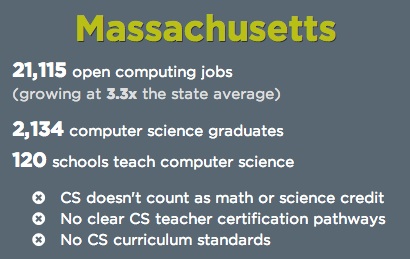
Finally, I was recently enlightened by my friends at the MassTLC Education Foundation on the rather pathetic state of our k-12 CS programs in Massachusetts. I view CS as basic literacy in the 21st century, yet in most publicmassCS_stats and private schools it is treated like an elective, not a core math or science requirement. In 2012, only 1000 students in Massachusetts took AP CS and 559 passed; of those who passed, only 24 were underrepresented minorities and 89 were female. There are also no standards or licensure for teachers who teach CS in k-12. According to this NPR story, only an estimated 10% of k-12 schools in our country teach computer science. This interactive data chart shows the steady decline of CS majors in the US. With all the money out there to invest in new technology and innovation, we are not making the same level of investment in the people we need to make these innovations a reality and sustainable into the future.

From the past we have learned that big issues such as the civil rights and feminist movements took large groups of likeminded people to go from controversy to significant policy and cultural changes. We take for granted that women can vote in the US and in many, but not all, other countries around the world and we tend to forget that not too many years ago, schools and busses were segregated. Today, we are fighting for equal pay and career opportunities for women and there is controversy about how few women there are studying CS, but there is a bigger issue to solve. If Venture Capitalists and technology industry leaders want to support these movements, we need to do more than just attend conferences and speak on panels. We need to change policy – like eliminating noncompetes in MA to allow talent to move where their passions take them instead of feeling trapped in their jobs or eager to depart from the field of technology altogether.  We need to band together instead of standing on hundreds of different platforms to solve a greater issue. We need to fund programs for young people – not just girls – that foster interest in creativity and technology. We need to enlighten high school kids about the opportunities in technology and be available to mentor these kids when they go to college. We need people who code.

Do you agree that we need to do more to encourage young people to code? Join me the week of December 8-14 for CS Ed Week where the MassTLC Education Foundation will be championing Hour of Code in cities and schools across all of Massachusetts. This national program is designed to inspire students to learn more, dream more and be more through Computer Science.